
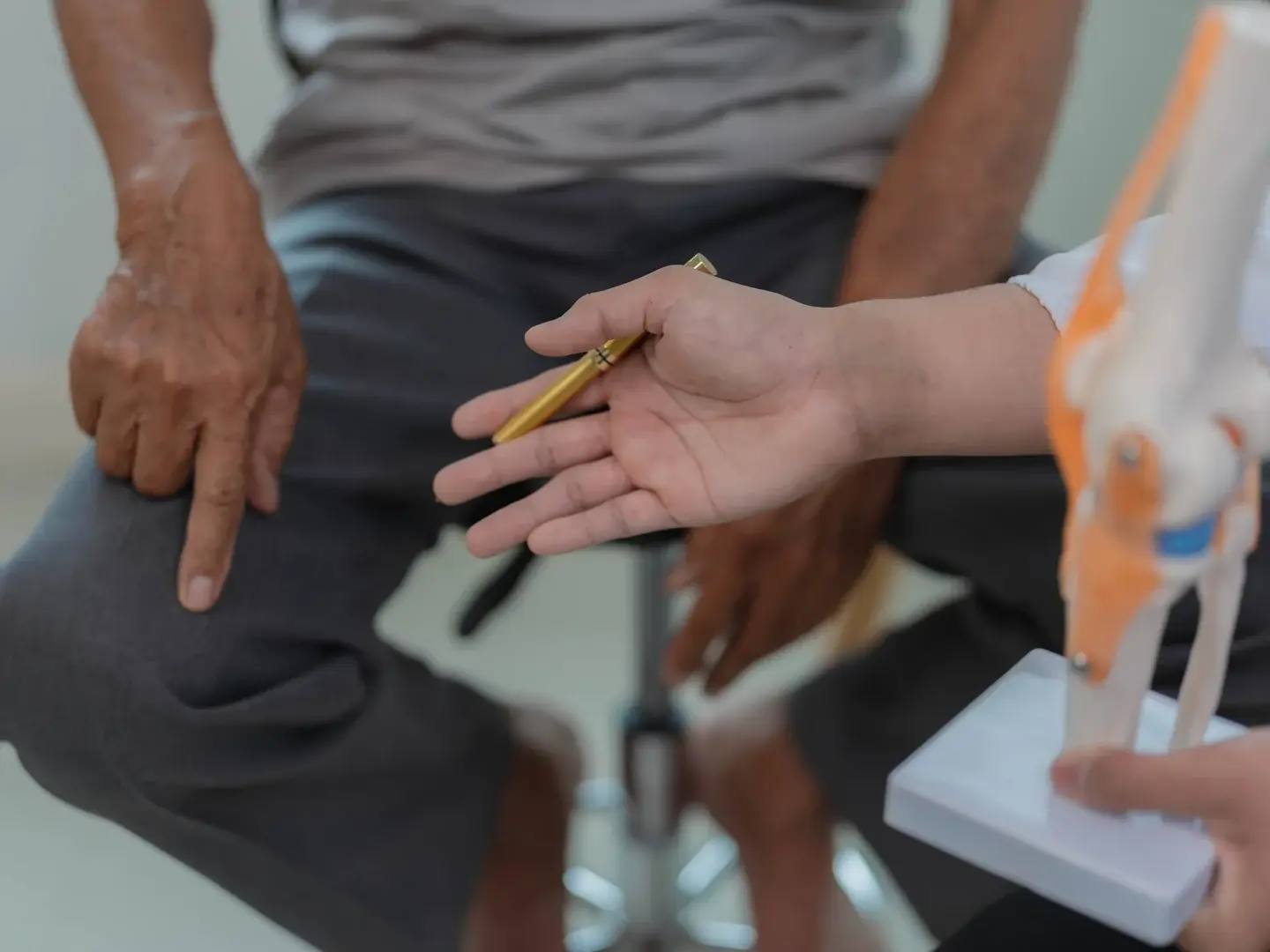
Sore, stiff joints make ordinary things harder, from climbing stairs to opening a jar. Joint pain treatment at Physical Medicine & Rehabilitation of NY & CT (PMR) starts by finding out why a joint hurts, then combines exercise, hands-on care and smarter ways to load it. We treat joint pain at our two offices in Danbury, CT and Brewster, NY.
What causes joint pain?
Pain can start inside a joint or in the tendons, ligaments, bursae and muscles around it, and each source is treated differently. Many have their own page in our list of conditions we treat.
Wear-and-tear arthritis
Osteoarthritis, the most common form of arthritis, develops as cartilage and the bone beneath it change over time, most often in the knees, hips, hands and spine. Typical signs are stiffness after rest that loosens within about half an hour, aching after activity and a grinding feeling. Age, an old injury and extra body weight raise the risk.
Injuries
A twist, fall or collision can sprain a ligament or tear cartilage, such as the knee’s meniscus. Swelling, giving way, catching or locking all call for a careful exam.
Tendon and bursa problems
Pain beside a joint, rather than deep inside it, often comes from an irritated tendon or bursa. Tendonitis tends to hurt with specific movements, such as reaching or gripping, while bursitis often causes a tender spot and pain when you lie on that side.
Posture, load and muscle balance
Joints share the work with the muscles around them. Weak hip muscles can overload the knees, and a sudden jump in training, yard work or repetitive tasks can strain any joint.
When joint pain needs a physician
Some joint pain comes from inflammatory arthritis, gout, infection or Lyme arthritis, a cause of knee swelling worth ruling out in our area. These need a physician’s diagnosis. See your doctor promptly if you have:
- A hot, red or swollen joint
- Fever, chills or feeling unwell
- A new rash
- Pain in several joints at once, especially the same joints on both sides
- Morning stiffness that lasts longer than an hour
If we spot these signs, we’ll point you to your primary care doctor or a rheumatologist.
Joint pain treatment at PMR
A thorough evaluation
Your clinician asks how the pain started and what changes it, then checks motion, strength, swelling, stability and how you walk, squat or reach. Nearby areas get checked too, since knee pain can start at the hip and shoulder pain at the neck. X-rays can be taken on site if they would change your plan.
A plan that combines care
- Exercise: joint pain physical therapy builds strength, motion and balance around the joint, with time in the on-site gym.
- Hands-on care: joint mobilization, chiropractic adjustments where appropriate, and soft-tissue work or massage to ease stiffness.
- Load management: changes to how you sit, lift, train or work so the joint can settle.
- Other options: cold laser therapy, or physician-led care through PMR’s pain management and physiatry service.
If extra weight is adding load to your knees or hips, nutritional counseling is part of Dr. Craig Tilden’s focus at our Danbury office.
How progress usually looks
Joint pain treatment usually aims first to calm pain and stiffness, then rebuild strength for the activities you care about. Progress is often gradual, and results vary. If a joint isn’t responding as expected, we’ll discuss imaging or a referral to an orthopedic specialist.
When to get urgent care
Call 911 or get to an ER right away for:
- A joint that looks deformed after an injury, or one you can’t move or put weight on
- A hot, swollen joint with fever or chills, which can signal a joint infection
- Shoulder, arm or jaw pain with chest pressure, shortness of breath or sweating
- Sudden pain, swelling and warmth in one calf, especially after surgery or a long trip
Frequently asked questions
Should I rest a painful joint or keep moving?
Unless you have a serious injury, gentle movement within a comfortable range usually helps more than complete rest, which can add stiffness and weakness. Ease off activities that sharply increase pain, and use ice or heat for comfort. A hot, badly swollen joint, or one that can’t bear weight, should be checked first.
Is joint pain always a sign of arthritis?
No. Arthritis is common, but joint pain also comes from sprains, cartilage tears, tendonitis, bursitis, muscle weakness and workload. Pain can even be referred from somewhere else, such as the low back sending pain toward the hip. A hands-on exam sorts out the source, which shapes your treatment.
Do I need an X-ray or MRI for joint pain?
Not always. Many joint problems can be identified from your history and a hands-on exam. X-rays help when a fracture or significant arthritis is suspected, and PMR can take them on site. If you need an MRI to look at cartilage or ligaments, we’ll explain why and coordinate with your physician.
Can physical therapy help joint stiffness?
Often, yes. Stiff joints usually respond to regular movement, and physical therapy uses targeted range-of-motion and strengthening exercises to help a joint move more freely. For many people with arthritis, stronger muscles take some load off the joint, which can bring joint pain relief over time.
Book an appointment for joint pain
Call the office nearest you to start joint pain treatment, or book online:
- PMR of Danbury, CT at 1 Padanaram Road, (203) 744-8013
- PMR of Brewster, NY at 1620 Brewster Town Center, (845) 279-1135