
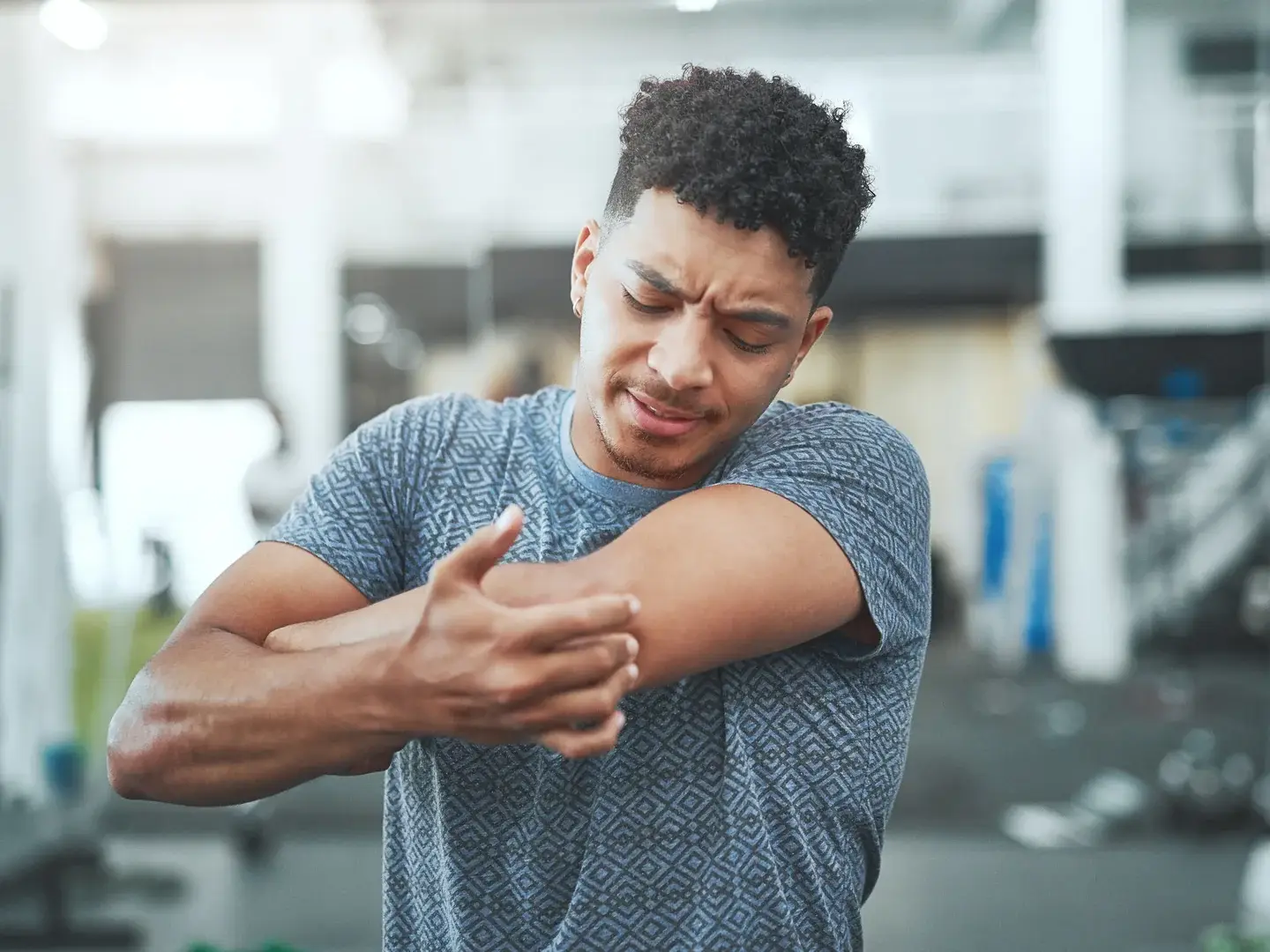
You don’t need to play tennis to get tennis elbow. Most people who develop it overload their forearm at work, in the garden or at the keyboard. At Physical Medicine & Rehabilitation of NY & CT (PMR), tennis elbow treatment centers on gradually strengthening the irritated tendon so it can handle gripping and lifting again. We see patients in Brewster, NY, and in Danbury, CT.
What is tennis elbow?
Tennis elbow, or lateral epicondylitis, is pain where the forearm muscles that lift your wrist attach to the bony bump on the outside of your elbow. Despite the name, it’s usually a tendon overload problem, called tendinopathy, rather than simple inflammation, so rest alone often doesn’t resolve it. Our tendonitis page covers similar problems in other tendons.
Symptoms
- Pain on the outside of the elbow that may spread into the forearm
- Pain when gripping, shaking hands, turning a doorknob or lifting a mug
- More pain lifting with your palm facing down
- A weaker grip and tenderness on the bony bump
Common causes
- Repetitive gripping and wrist work in carpentry, plumbing, painting and other hand-tool jobs
- Lifting with your palm down, such as carrying bags or tools
- Racquet sports, especially with backhand technique problems or the wrong grip size
- Long hours at a keyboard and mouse
- Sudden jumps in activity, like a weekend of yard work
It’s most common between ages 30 and 50.
When to get urgent care
A sudden elbow injury is a different problem. Get prompt care for:
- An elbow that looks deformed, swells quickly or won’t bend or straighten after a fall. Go to the ER.
- A red, hot, swollen elbow, especially with fever or a soft swelling over the back of the elbow. Get same-day care to rule out infection.
- A sudden pop at the front of the elbow followed by bruising and a bulge in the upper arm. See a doctor within days, as a torn biceps tendon may need early repair.
- Worsening numbness or weakness in your hand, or a hand that turns cold or pale. Get urgent medical care.
How PMR evaluates elbow pain
Not all outer elbow pain is tennis elbow. A pinched nerve, pain referred from the neck, arthritis or a ligament injury can feel similar. Your clinician presses on specific spots, tests resisted wrist and finger lifting, measures grip strength and checks your neck and nerves. X-ray imaging is available if arthritis or an injury is suspected.
What tennis elbow treatment involves
The aim is a stronger tendon, not just a quieter one.
Tennis elbow physical therapy and loading exercise
Progressive loading is the core of care. Plans often start with isometric holds, pressing against resistance without moving the wrist, then progress to slow wrist lifting and lowering with light weights, plus grip work. Mild discomfort that settles by the next day is usually fine. Our physical therapy page explains more.
Activity changes and bracing
Lift with your palms facing up, use both hands, choose tools with thicker handles and take regular breaks. Racquet players may need a technique or grip-size check, and a counterforce brace can ease pain during heavy tasks.
Manual therapy
Soft-tissue work and gentle elbow and wrist mobilization can make exercise more comfortable, and chiropractic care can address a neck or upper back that contributes.
Shockwave for tennis elbow
Radial pressure wave therapy, given alongside your loading program, may help some people whose symptoms have lasted for months despite exercise. PMR provides shockwave therapy at its Danbury and Brewster offices.
Medical options
Cortisone injections may ease pain in the short term, but symptoms often return, so many clinicians use them sparingly. Surgery is rarely needed and is considered only after many months of good care.
How long tennis elbow takes to improve
Tendons adapt slowly. With consistent tennis elbow treatment, many people notice less pain within several weeks, but building lasting strength often takes three months or more. Tennis elbow can linger for six months to a year, and flare-ups are common if you return to heavy gripping too fast. Most cases do settle with time and good care, though results vary.
Frequently asked questions
Does shockwave therapy help tennis elbow?
Research on shockwave for tennis elbow is mixed, but some people with long-standing symptoms report less pain after a course of treatment. It’s usually considered when pain has lasted for months despite a good exercise program, and it works alongside strengthening rather than replacing it.
Should I wear a tennis elbow brace?
A counterforce strap worn a couple of finger-widths below the painful spot can reduce pain during gripping or lifting for some people, helping you stay active while the tendon recovers. Keep it snug but not tight. A brace doesn’t strengthen the tendon, so treat it as a short-term aid alongside your loading exercises.
Is tennis elbow the same as golfer’s elbow?
No, though they’re similar. Tennis elbow affects the tendons on the outside of the elbow, which lift the wrist. Golfer’s elbow affects the tendons on the inside, which bend the wrist and fingers. Both are overload problems and are usually treated with a similar approach of gradual strengthening, activity changes and hands-on care.
Book a tennis elbow evaluation
If gripping, lifting or typing has started to hurt, tennis elbow treatment can start with one call:
- Danbury, CT office: (203) 744-8013
- Brewster, NY office: (845) 279-1135
Or request an appointment online. For other problems, browse all the conditions we treat.