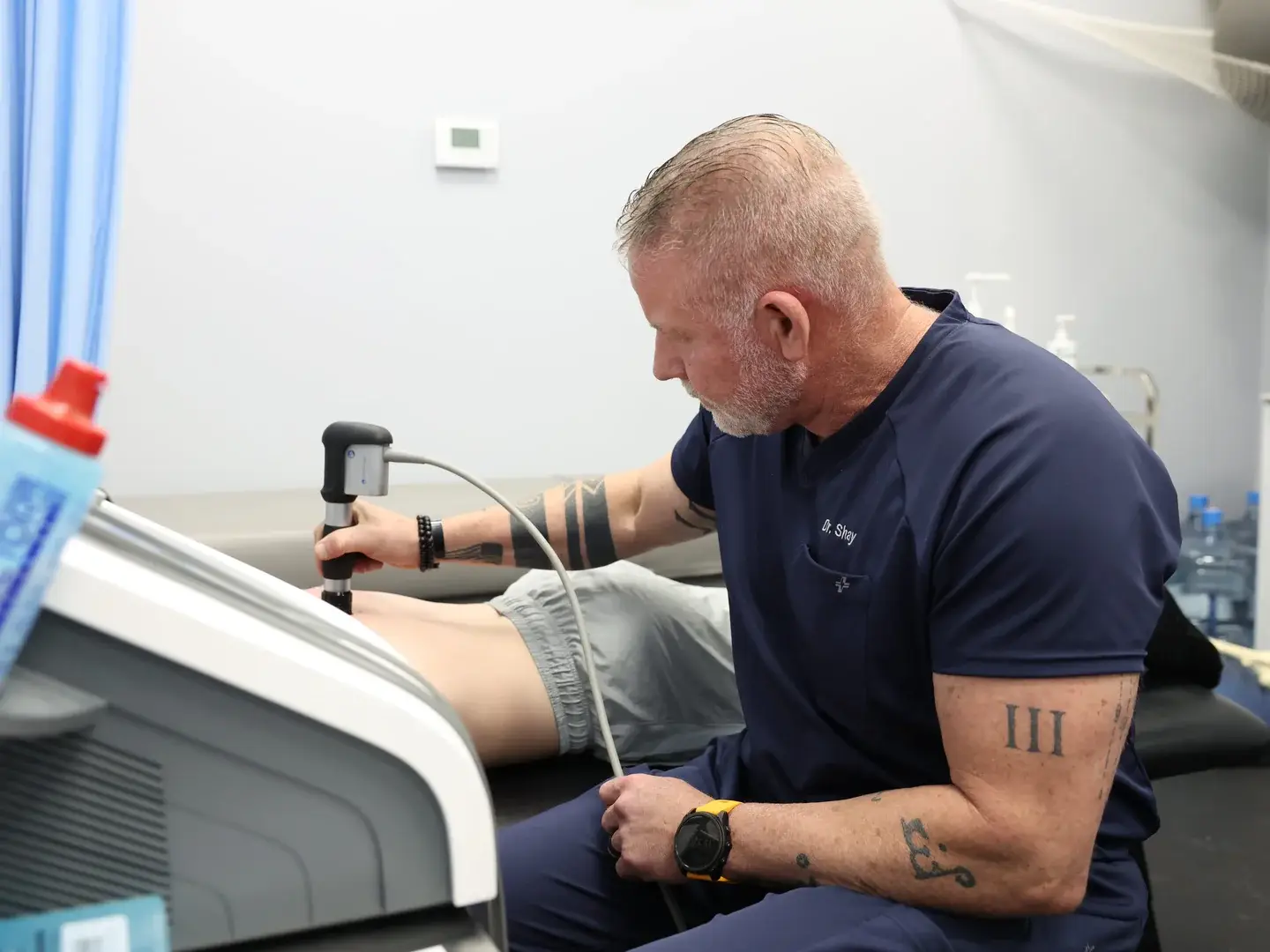
Shockwave therapy is a non-surgical treatment that uses pulses of acoustic pressure to treat long-standing tendon and soft-tissue pain, such as plantar fasciitis, Achilles tendinopathy and tennis elbow. Physical Medicine & Rehabilitation of NY & CT (PMR) provides radial pressure wave (RPW) therapy, one type of shockwave, at our Danbury, CT and Brewster, NY offices, almost always alongside a structured exercise program.
What is shockwave therapy?
A shockwave is a short, intense burst of pressure energy that travels through tissue the way sound does. Medicine first used the technology to break up kidney stones. Lower-energy versions were later adapted for tendons and other soft tissue, a treatment often called extracorporeal shockwave therapy (ESWT) or acoustic wave therapy.
Extracorporeal means the energy starts outside the body. A handheld applicator delivers the pulses through the skin, with no needles, incisions or medication.
How shockwave may work
Researchers are still studying why shockwave helps some people. The main theories are not settled science:
- Stimulating repair: mechanical pulses may prompt tendon cells to increase repair activity.
- Blood flow: treatment may boost circulation and small blood vessel growth in slow-healing tissue.
- Calcium deposits: in calcific tendinitis, shockwave may help break up calcium buildup inside a tendon.
- Pain signaling: pulses may temporarily make nerve endings in the area less sensitive.
Radial vs focused shockwave
- Radial pressure wave therapy: in most radial devices, compressed air drives a small projectile inside the handpiece. The energy is strongest at the skin and spreads outward, like ripples from a stone dropped in a pond, which suits wider, shallower areas such as the heel, Achilles tendon and elbow. Strictly speaking, these are pressure waves rather than true shockwaves.
- Focused shockwave: the device concentrates energy at a chosen depth, a bit like a magnifying glass focusing light, so it can reach deeper tissue in a smaller target area.
PMR uses radial shockwave therapy. Both types have been studied, and neither is the right choice for every problem.
Conditions shockwave therapy may help
Shockwave is usually considered for problems that have lasted several months and haven’t improved enough with exercise and other standard care. Research support is strongest for:
- Plantar fasciitis: shockwave therapy for plantar fasciitis is among the most studied uses, especially for chronic heel pain.
- Calcific tendinitis of the shoulder: chalky calcium buildup inside a rotator cuff tendon.
- Lower-limb tendonitis and tendinopathy: Achilles pain, jumper’s knee and outer hip pain, though results for jumper’s knee are mixed.
- Tennis elbow: some studies show benefit and others don’t.
Shockwave isn’t a treatment for a fully torn tendon or a fracture. In studies, many people with the conditions above report less pain and better function after a course of treatment. Not everyone responds, and improvement often builds gradually over the following weeks.
What to expect during treatment
- Evaluation: we take a history, examine the area, test how the tendon handles load and screen for anything that makes shockwave unsafe.
- Treatment: after gel is applied over the most sensitive spots, rapid pulses feel like firm tapping or thumping, with a clicking sound. Intensity starts low and rises to your tolerance, and each area takes only a few minutes.
- Afterward: temporary soreness, redness or mild swelling is common for a day or two, but most people resume normal daily activity right away.
- The series: treatment is given as a short course of sessions, with exercise between visits.
Combining shockwave with physical therapy
Tendons respond to load, so most tendon rehab is built around progressive strengthening. Programs often begin with isometric holds, which can ease tendon pain, then build toward heavier strength work and, later, quicker movements that match your sport or job. Shockwave may lower pain enough to make that loading easier to tolerate.
At PMR, shockwave is usually one piece of a physical therapy plan that may also include chiropractic care, massage therapy, cold laser therapy and supervised work in our on-site gym. We also look at what overloaded the tendon, such as footwear, a sudden jump in training or repetitive gripping at work. See how these fit together on our services page.
Safety: who shouldn’t have shockwave?
Radial shockwave is generally well tolerated. Common side effects are short-lived soreness, redness, swelling, bruising or tingling, and serious problems are uncommon when people are screened first. Shockwave should not be used:
- During pregnancy
- Over a tumor or an area of infection
- With a bleeding disorder or blood-thinning medication, unless your clinician clears it
- Over open growth plates in children and teens
- Over or near a pacemaker or other implanted electronic device
Also tell us about any recent cortisone injection in the area or nerve problems such as neuropathy.
Cost and insurance
Coverage varies, and many health plans consider shockwave for tendon problems investigational, which often makes it an out-of-pocket cost. We’ll go over costs before treatment begins; for billing questions, call (203) 744-8014.
When to get urgent care
Call 911 or head to an emergency room if you notice:
- A snap felt or heard in a tendon, then being unable to bear weight or move the joint normally
- A swollen, painful calf, or sudden chest pain or breathlessness
- A red, hot, swollen joint together with fever or chills
Frequently asked questions
Is shockwave therapy the same as ultrasound therapy?
No. Therapeutic ultrasound uses high-frequency sound waves, often to gently warm tissue. Shockwave delivers separate high-pressure pulses with a strong mechanical effect. Both use a handheld applicator and gel, which is why they’re often confused, but they feel different and serve different purposes.
How many shockwave sessions will I need?
Most people receive a short series rather than a single treatment. The exact number depends on the condition, how long you’ve had it and how you respond. If you aren’t seeing meaningful change by the end of the series, we’ll discuss other options instead of continuing indefinitely.
Does shockwave therapy hurt?
Some discomfort is normal, particularly over the most irritated tissue, and people often describe it as intense tapping. The clinician starts gently and raises the intensity gradually, so most people tolerate it well. Soreness for a day or two afterward is expected. Tell your clinician if the discomfort is more than you can manage.
Book a shockwave evaluation
Looking for shockwave therapy near you? Start with an evaluation at one of our offices:
- Shockwave therapy in Danbury, CT: PMR of Danbury, CT, 1 Padanaram Road, (203) 744-8013
- Shockwave therapy in Brewster, NY: PMR of Brewster, NY, 1620 Brewster Town Center, (845) 279-1135
You can also book through our online appointment request form.