
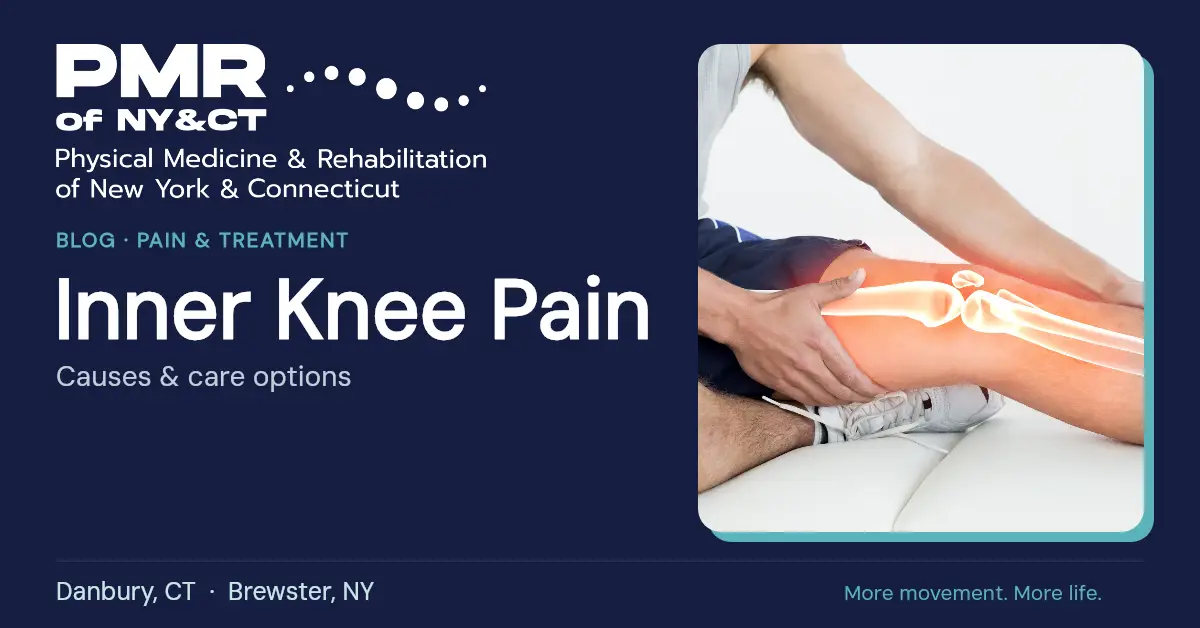
Pain along the inside of your knee can start with a twist on the soccer field, build slowly over months of running or show up every time you climb the stairs. Inner knee pain is one of the most common knee complaints, and it usually traces back to a handful of structures packed into that small area.
Where the pain sits, how it started and what makes it worse offer clues to the cause.
What sits on the inside of your knee
Clinicians call pain in this area medial knee pain. Several structures share the space:
- The medial collateral ligament (MCL), a strong band that keeps the knee from buckling inward
- The medial meniscus, a C-shaped cartilage cushion between your thighbone and shinbone
- The inner joint surfaces, which carry much of your weight with each step
- The pes anserine bursa, a small fluid-filled sac just below the joint on the inner shin
Because the MCL attaches to the medial meniscus, a hard blow or twist can injure both.
Common causes of inner knee pain
MCL sprain
An MCL sprain usually follows a blow to the outside of the knee, such as a tackle, or a twist with the foot planted. Expect pain along the inner edge of the knee, swelling and a wobbly feeling when you change direction. When the MCL is the only structure injured, it usually heals without surgery.
Medial meniscus tear
In active people, a medial meniscus tear often happens when the knee twists while the foot stays planted. In middle-aged and older adults, tears can also develop gradually from wear. Common signs include pain right at the joint line, swelling that builds over a day or so, and catching, locking or giving way.
Knee osteoarthritis
The inner side of the knee is the part most often affected by knee osteoarthritis. It typically causes a gradual ache that worsens with activity, stiffness after rest that loosens with movement, and sometimes swelling or grinding. Age and past knee injuries raise the risk. Our arthritis page explains treatment options.
Pes anserine bursitis
Pes anserine bursitis causes tenderness just below the joint on the inner shin. It often hurts on stairs, when rising from a chair or at night when your knees press together, and it is common in runners and people with knee arthritis. Learn more on our bursitis page.
Less common causes
Pain can also come from an irritated fold of joint lining called a plica, a bone stress injury or the hip. In children and teens, knee pain with a limp can come from a hip problem, so have it checked promptly, and the same day if they can't put weight on the leg.
What you can do at home
For mild pain without major swelling or instability, try these steps for a week or two:
- Avoid pivoting, deep squats and kneeling, but keep moving within comfort.
- Ice the knee for 15 to 20 minutes after activity, with a cloth between the ice and your skin. Heat may feel better for arthritis stiffness.
- Use a compression sleeve and raise your leg to reduce swelling.
- Sleep with a pillow between your knees if lying on your side hurts.
- Ask your doctor or pharmacist whether an over-the-counter pain reliever is right for you.
As pain settles, thigh and hip strengthening supports the joint.
How inner knee pain is treated
Treatment depends on the cause, and most people improve without surgery. Options include:
- Physical therapy to strengthen the thigh and hip, restore motion and rebuild balance
- A hinged brace while an MCL sprain heals
- An X-ray to check for arthritis or a fracture, and sometimes an MRI for a suspected tear
- Injections for arthritis or bursitis, discussed with a physician
- Surgery for a knee locked by a torn meniscus or for advanced arthritis that hasn't responded to other care
At Physical Medicine & Rehabilitation of NY & CT (PMR), knee pain treatment starts with an exam to pinpoint the cause.
When inner knee pain needs an exam
Make an appointment if pain lasts more than a week or two despite home care, the knee keeps swelling, it catches, locks or gives way, you can't fully straighten it, or pain wakes you at night.
Get same-day care if you couldn't put weight on the leg after an injury or heard a pop followed by fast swelling. Go to an emergency room if the knee looks deformed, or for a hot, red, swollen knee with fever or chills, which can signal a joint infection.
Frequently asked questions
Why does the inside of my knee hurt with no injury?
Gradual pain often comes from osteoarthritis, bursitis or a wear-related meniscus tear. A recent jump in running, hiking or stair climbing can also overload the area, and occasionally the pain is referred from the hip. If the ache lasts more than a couple of weeks or keeps returning, an exam can sort out the cause.
How long does an MCL sprain take to heal?
It depends on the grade. A mild sprain often settles within a few weeks, while a complete tear takes longer. Most isolated MCL injuries heal without surgery, usually with a hinged brace and an exercise program that rebuilds strength and stability. Returning to sports before the knee feels stable in side-to-side movements raises the risk of another injury.
Is walking good for inner knee pain?
Often, yes. For arthritis or bursitis, walking at a comfortable pace on flat ground keeps the joint moving and the muscles strong. After a fresh injury with swelling or instability, limit walking until the knee is checked. If walking makes you limp or the pain builds over the next day, cut back and ask your provider.
Talk with our team
If inner knee pain is making stairs, workouts or sleep harder, we can help find the cause and build a plan around your routine. Request an appointment and we will contact you to schedule a visit at PMR of Danbury or PMR of Brewster.