
Different tools, an individual decision
Shockwave therapy and cold laser therapy are not two names for the same treatment. One uses mechanical pressure waves; the other uses low-intensity light. Neither is the best choice for every person or every painful condition. At PMR, the decision starts with an evaluation and a discussion of your goals.
Shockwave: mechanical pressure waves
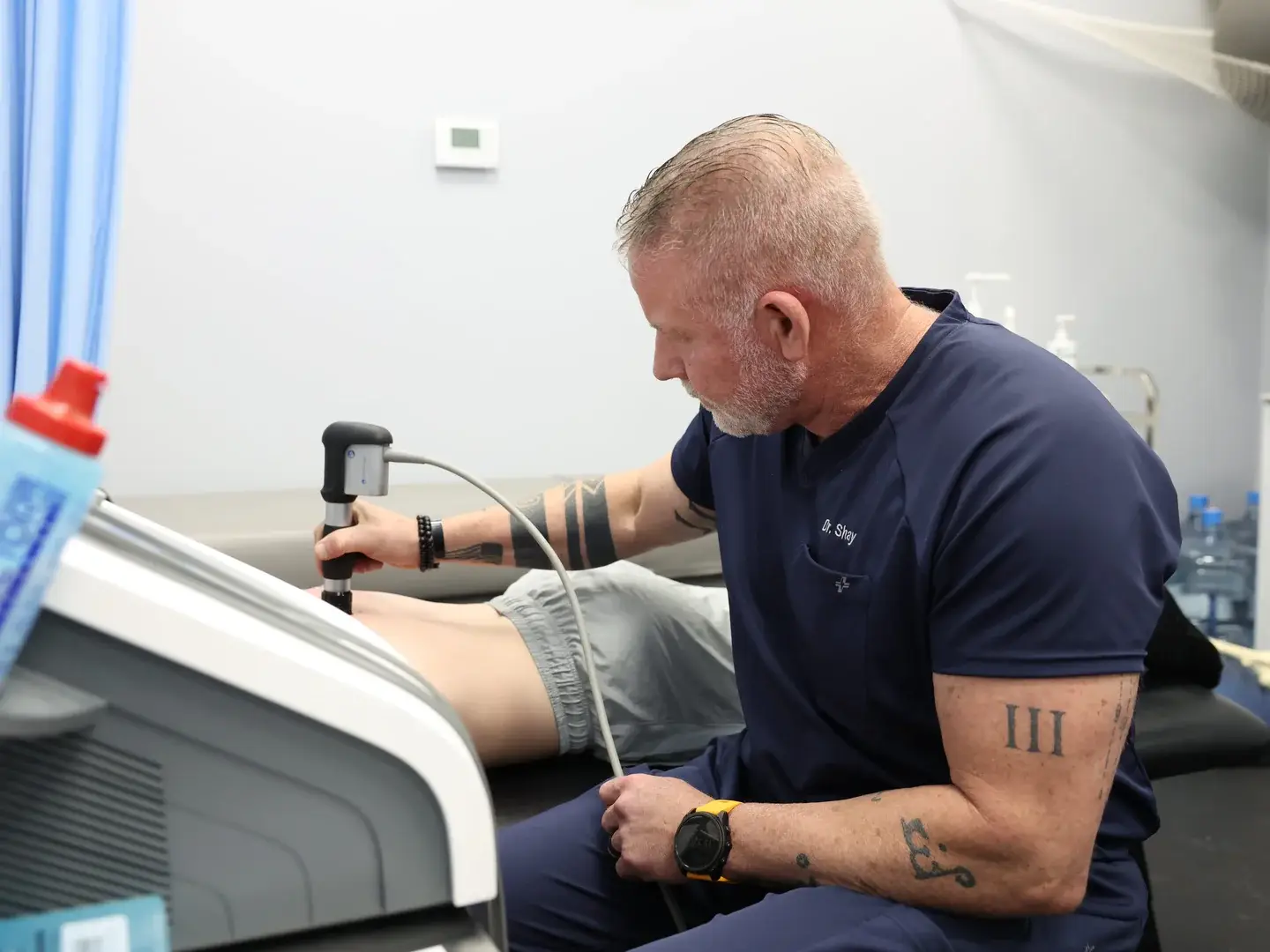
PMR’s shockwave service uses radial pressure wave treatment. A handheld applicator delivers pulses through the skin, usually with contact gel. The sensation may feel like repeated tapping and can be uncomfortable over a sensitive area. Ask the clinician how intensity and comfort are managed.
Read PMR’s shockwave therapy guide for the treatment process and candidacy. The Royal National Orthopaedic Hospital patient guide describes radial treatment for selected persistent tendon and heel concerns, as well as possible adverse effects and reasons it may not be appropriate.
Cold laser: low-level light
Cold laser therapy is also called low-level laser therapy or photobiomodulation. It applies low-intensity light rather than pressure pulses. It is different from a surgical laser that cuts tissue, and a home light device should not be assumed to have the same specifications or intended use.
Read PMR’s cold laser guide. Evidence depends on the condition and treatment parameters. The NCCIH overview of complementary approaches for low-back pain discusses limitations in the evidence for low-level laser therapy. Evidence about one condition should not be treated as proof for every use.
How to compare the options
- Purpose: Ask what specific finding the treatment is intended to address.
- Experience: Pressure pulses and light application feel different; discuss comfort and possible side effects.
- Evidence: Ask what research supports the option for your diagnosis, rather than relying on general claims.
- Safety: Share medications, recent procedures, implanted devices, pregnancy and other health conditions with the clinician.
- Plan: Ask how treatment fits with exercise, hands-on care or another recommended approach.
Cost, visits and reassessment
Ask for the expected charges and whether the service is covered by your plan before starting. Do not assume that insurance benefits for physical therapy automatically cover every additional therapy. The clinician should explain the proposed course and how progress will be reviewed; outcomes cannot be guaranteed.
Discuss your options in Danbury or Brewster
Both therapies are available through PMR’s Danbury office and Brewster office. An appointment request is a starting point for evaluation, not a commitment to a particular treatment. Learn how chiropractic care and physical therapy can fit together.