
Published by PMR of NY & CT
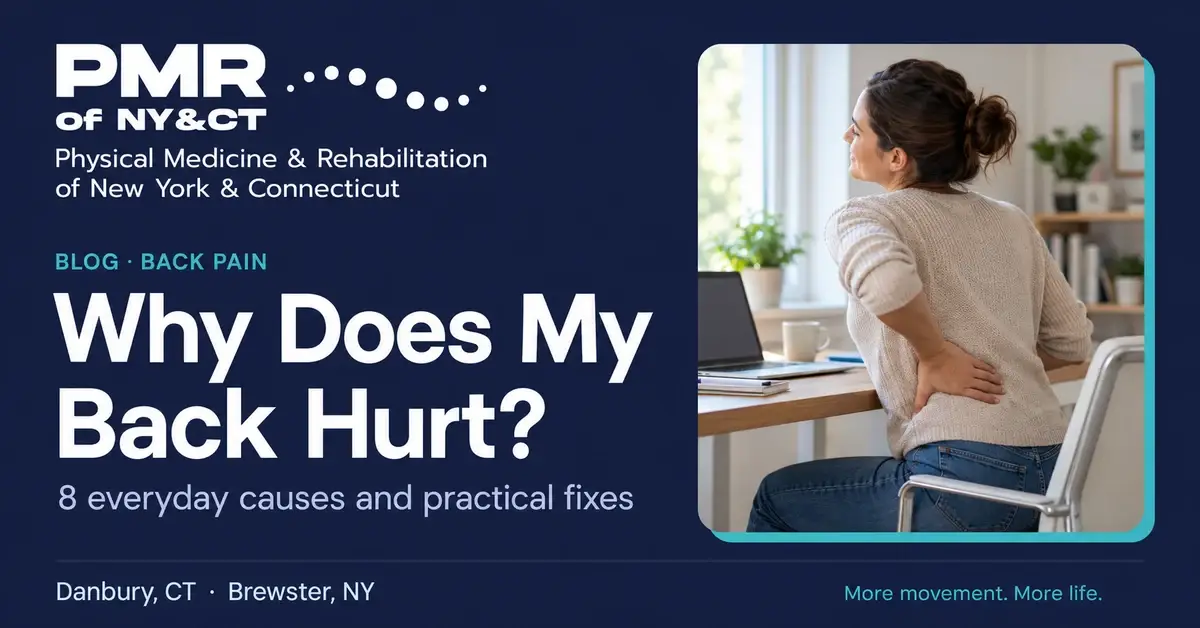
If you woke up this morning with a stiff, aching back, you're in good company. About 8 in 10 adults deal with back pain at some point in their lives, and it's one of the most common reasons people in the Danbury and Brewster area walk through our doors.
Here's the part that often gets lost: most back pain isn't caused by something “broken.” It usually comes from everyday habits that load the spine in ways it doesn't like, hour after hour, day after day. That's good news, because habits can change.
In this guide, the team at Physical Medicine & Rehabilitation of NY & CT (PMR) walks through eight of the most common everyday causes of back pain, what you can do about each one at home, and the signs that mean it's time to get checked out.
First, some reassurance about back pain
Most back pain is “mechanical.” It comes from muscles, joints, ligaments and discs working under strain, not from disease. Acute episodes often ease within a few days to a few weeks, and staying gently active tends to speed that along more than bed rest does.
It's also worth knowing that pain doesn't always equal damage. Imaging studies regularly find disc bulges and age-related changes in people who have no pain at all. So if your back hurts, the first question usually isn't “What's damaged?” It's “What's irritated, and what's been irritating it?”
That's where everyday habits come in.
8 everyday causes of back pain (and what to do about them)
1. Sitting for long stretches
A desk job, a long drive on I-84 or I-684, a Metro-North commute from Brewster. Sitting itself isn't harmful, but sitting still for hours is. Your hip flexors tighten, your glutes and core switch off, and your lumbar discs sit under sustained load. By mid-afternoon, your lower back is doing work your hips should be sharing.
What helps:
- Change position every 30 to 45 minutes. Stand, walk to refill your water, or do a few hip hinges. Movement matters more than the “perfect” chair.
- Set your chair so your hips are level with or slightly above your knees, with your feet flat and the top of your screen at eye height.
- On long drives, stop every hour or so and walk for two minutes. A small rolled towel behind your low back can take the edge off.
2. Lifting with your back instead of your hips
The classic back injury usually isn't a heavy barbell. It's a laundry basket, a car seat, a bag of mulch: something light enough that you didn't bother to set up for it. Bending from the waist with a rounded back and then twisting loads the discs and strains the muscles that support them.
What helps:
- Hinge at the hips, bend your knees, and keep the load close to your body.
- Face what you're lifting. Move your feet instead of twisting your spine.
- Brace gently, as if someone were about to poke your stomach, and breathe out as you stand up.
3. A weak core and stiff hips
Your lower back relies on its neighbors: the abdominals, glutes and hip muscles that share the work of bending, lifting and standing. When those muscles are weak, or the hips are stiff from sitting, the lumbar spine takes up the slack, and it tends to complain about it.
What helps:
- Walk. Twenty to thirty minutes most days is one of the best-studied ways to reduce and prevent low back pain.
- Add a few simple exercises. Glute bridges, bird-dogs and dead bugs build support without straining the spine.
- Stretch the front of the hips (a half-kneeling hip flexor stretch works well) after long periods of sitting.
4. Fall yard work and winter shoveling
Autumn in Fairfield and Putnam counties means leaves, and before long, snow. Raking and shoveling combine three things backs dislike: repetitive bending, twisting under load, and doing it all after months of not doing it.
What helps:
- Warm up first with a five-minute walk and a few gentle trunk rotations.
- Switch sides every few minutes when raking. When shoveling, push the snow rather than lifting it when you can, and take smaller scoops.
- Break the job into chunks. Two 30-minute sessions beat one exhausting two-hour push.
5. Your sleep setup
You spend roughly a third of your life in bed, so your mattress and sleeping position matter. A sagging mattress or a stomach-sleeping habit can leave your spine arched or twisted for hours at a time.
What helps:
- Side sleepers: place a pillow between your knees. Back sleepers: tuck one under your knees.
- A mattress that sags visibly or is more than about eight years old may be past its best. Medium-firm suits most people with back pain.
- For a deeper dive, read our guide to the best sleeping position for back pain.
6. Looking down at screens
Lower back pain gets the headlines, but hours of looking down at a phone or laptop pull the head forward and round the upper back. That's a common recipe for upper back pain, shoulder blade pain and tension headaches.
What helps:
- Bring the screen to your eyes, not your eyes to the screen. Raise your laptop and hold your phone higher.
- Every hour, do a few chin tucks and roll your shoulders back and down.
- Open the chest with a doorway stretch, or lie on a rolled towel placed along your spine for a minute or two.
7. Stress and muscle tension
Stress isn't “all in your head.” When you're under pressure, the muscles along the spine tense and guard, sleep gets lighter, and your nervous system becomes more sensitive to pain signals. Many people notice their back flares during a demanding week at work.
What helps:
- Protect your sleep and schedule real breaks.
- Try five minutes of slow breathing (in for four counts, out for six) once or twice a day.
- Keep moving. Walking, yoga and swimming ease both tension and pain.
8. Doing too much, too soon
The first warm Saturday after a long winter, a new gym program, a weekend of travel sports with the kids. “Weekend warrior” injuries happen when the amount of activity jumps faster than your body can adapt to it.
What helps:
- Build up gradually. A good rule of thumb is to increase activity by no more than about 10 percent a week.
- Don't skip the warm-up or the cool-down.
- Respect early twinges. A day or two of lighter activity now can prevent weeks of pain later.
Back pain relief you can start today
Whatever the cause, these steps are safe for most people with a new, uncomplicated backache:
- Keep moving. Short, frequent walks usually help more than rest.
- Use heat or ice, whichever feels better, for up to 20 minutes at a time with a towel between the pack and your skin.
- Try gentle mobility work such as cat-cow, knee-to-chest and child's pose. Stop any stretch that sends pain farther down your leg.
- Change positions often. There's no single “right” posture; the best posture is your next one.
- Sleep on your side with a pillow between your knees.
If pain hasn't improved after a couple of weeks of self-care, it's worth getting a professional evaluation so you're not guessing.
When to see a professional about back pain
Book an evaluation if:
- Pain hasn't improved after two to three weeks, or it keeps coming back
- Pain spreads into your buttock or leg, or you notice numbness or tingling (possible signs of sciatica or a herniated disc)
- You're avoiding work, exercise or the activities you enjoy because of your back
- The pain started after a fall, a car accident or a sports injury
Go to the nearest emergency room, or call 911, if back pain comes with:
- Loss of bladder or bowel control, or trouble passing urine
- Numbness in the groin, genitals or inner thighs
- Sudden or worsening weakness in one or both legs
- A high fever, chills or feeling very unwell
- A serious injury
Also see a doctor promptly if pain wakes you at night, you've had unexplained weight loss, or you have a history of cancer.
How PMR treats back pain in Danbury, CT and Brewster, NY
At PMR, chiropractors, physical therapists, massage therapists, an acupuncturist and a physiatry and pain-management team work under one roof. That matters for back pain, because the right treatment depends on what's actually irritated: a muscle, a joint, a disc or a nerve.
Your first visit starts with a conversation about your symptoms, your history and what your days ask of your back, followed by a hands-on exam of how you bend, lift and move. Most people don't need imaging to begin care, but PMR offers on-site X-ray and EMG and nerve testing when it would change the plan.
From there, your team recommends a mix that fits your findings. That may include:
- Chiropractic care to restore joint motion and ease stiffness
- Physical therapy to build hip and core strength and retrain lifting and movement, progressing in the on-site gym
- Medical massage to calm muscle spasm so exercise feels easier
- Spinal decompression for some disc-related cases, used alongside exercise rather than in place of it
- Acupuncture or dry needling as an addition for lingering pain
- Physiatry and pain management when pain persists or a nerve is involved
Because the providers share notes, your plan stays coordinated as you progress. Results vary from person to person, but the goal is always the same: less pain with daily tasks, easier movement and a home program that helps you handle flare-ups on your own.
Frequently asked questions about back pain
Is it better to rest or keep moving with back pain?
For most new back pain, gentle movement beats bed rest. Short walks and light daily activity help muscles relax and keep joints moving. Rest for a day if you need to, then start moving again as pain allows.
Should I use heat or ice for back pain?
Either can help, so use whichever feels better. Ice is often preferred in the first day or two after a strain, while heat tends to ease stiffness and muscle tension. Limit each session to about 20 minutes and protect your skin.
Should I see a chiropractor or a physical therapist for back pain?
You don't have to choose. Chiropractors focus on joint motion and hands-on care; physical therapists focus on strength, mobility and movement retraining. Many people with back pain benefit from both, which is why PMR offers them in the same office.
How long does back pain usually last?
Acute back pain often eases within a few days to a few weeks. Pain that lasts longer than about three months is considered chronic and usually needs a structured, exercise-based plan. If yours isn't improving after a couple of weeks, get it checked.
Ready to get your back on track?
You don't have to figure out your back pain alone. Request an appointment online or call the PMR office nearest you:
- PMR of Danbury, CT — 1 Padanaram Road, Danbury, CT 06811 — (203) 744-8013
- PMR of Brewster, NY — 1620 Brewster Town Center, Brewster, NY 10509 — (845) 279-1135
This article provides general information and does not replace an individual evaluation. If you have severe or worsening symptoms, seek medical care.
More from the PMR Blog
Continue exploring articles in this topic category.