
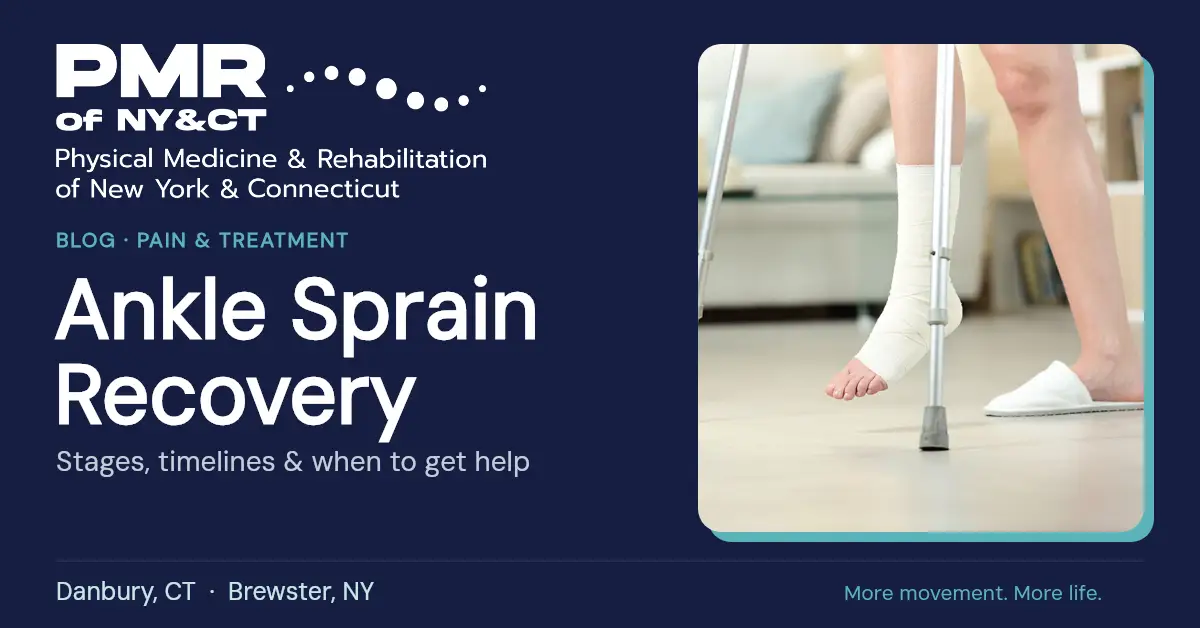
One wrong step off a curb or onto a teammate's foot, and your ankle swells within minutes. Sprains are among the most common injuries in sports and everyday life, and most heal well without surgery. Good ankle sprain recovery depends less on how long you rest and more on what you do after the first few days.
Pain usually fades before the ligaments have fully healed and before your balance has caught up. That gap is a big reason people sprain the same ankle again.
What happens when you sprain your ankle
A sprain is a stretch or tear in the ligaments, the tough bands that hold the ankle bones together. Most happen when the foot turns under, stretching the ligaments on the outside of the ankle. Clinicians often describe three ankle sprain grades:
- Grade 1: stretched ligaments, mild swelling, little trouble walking
- Grade 2: a partial tear, with more swelling, bruising and pain when standing
- Grade 3: a complete tear, often with major swelling and an ankle that feels loose
A high ankle sprain affects the ligaments just above the ankle that hold the two lower leg bones together. It often happens when the foot is forced to twist outward, and it usually takes longer to heal.
A realistic ankle sprain recovery timeline
Every ankle heals at its own pace, but there are general patterns. Mild sprains often feel close to normal within one to three weeks, moderate sprains commonly take three to six weeks, and severe tears or high ankle sprains can take a few months.
Ligaments keep remodeling for months after the pain settles, so feeling better doesn't mean the ankle is ready for a pickup game.
The first few days: protect and calm it
In the first two to three days, protect the ankle without shutting it down:
- Use crutches or a brace if walking hurts a lot, and bear weight as comfort allows.
- Raise the ankle above heart level when you can.
- Wear a snug compression wrap, and loosen it if your toes tingle or turn pale.
- Ice for 15 to 20 minutes at a time, with a cloth between the ice and your skin.
- Start gentle, pain-free movement, such as slowly pointing and flexing your foot.
Clinicians now favor early, protected movement over long rest, since stiff ankles recover slowly.
Ankle rehab exercises that rebuild strength and balance
Once you can walk with only mild discomfort, the focus shifts to rebuilding. A physical therapy program typically moves through these steps:
- Motion: calf stretches and ankle circles to restore bending and pointing.
- Strength: resistance band exercises in every direction, then calf raises on both legs and later on one.
- Balance: standing on the injured leg, then progressing to eyes closed or an unstable surface.
- Sport skills: hopping, cutting and quick changes of direction, once the earlier steps are easy.
Balance work matters most. A sprain can disrupt the signals that tell your brain where your foot is, and retraining them helps lower your risk of another sprain.
Joint mobilization and soft tissue work may help restore motion alongside exercise. At Physical Medicine & Rehabilitation of NY & CT (PMR), our chiropractic care and therapy teams can work on this together.
Returning to sport without another sprain
The last stage of ankle sprain recovery is the one most often skipped. Before returning to sports, your injured ankle should be close to the other one for strength, motion and single-leg balance. Wearing a brace or tape for sports over the following months may lower the chance of another sprain.
An ankle that keeps rolling or feeling wobbly may have chronic ankle instability. It often improves with focused rehab, and surgery is an option when it doesn't.
When an ankle injury needs an exam
Get your ankle checked if:
- You couldn't take four steps right after the injury, or can't now
- The bony bumps on either side of the ankle, or the inner or outer edge of your midfoot, hurt when pressed
- You felt a pop at the back of your heel and can't push off, a possible Achilles tendon tear
- Pain and swelling aren't improving after a week or two
Doctors use the Ottawa ankle rules, which include the first two signs, to decide whether an X-ray is needed. Go to an emergency room if your ankle looks deformed or your foot turns numb, cold or pale. After a leg injury, especially in a boot or cast, get same-day care for a painful, swollen calf, and call 911 for sudden shortness of breath or chest pain, which can signal a blood clot in the lungs.
Frequently asked questions
Should you walk on a sprained ankle?
For most mild and moderate sprains, yes, within your comfort level. Gentle weight bearing, sometimes with a brace or crutches at first, helps the ligaments heal and keeps the ankle from stiffening. If you can't take a few steps without severe pain, or walking gets harder instead of easier, have it examined.
Why is my ankle still swollen weeks later?
Some swelling, especially at the end of the day, is common for several weeks after a moderate sprain. Raising your foot, wearing a compression sleeve and keeping up with your exercises usually help. Swelling that keeps getting worse, or comes with redness, warmth or a painful calf, deserves a prompt exam.
Should I use heat or ice on a sprained ankle?
Ice is the usual choice in the first few days because it may ease pain. Later, some people find gentle heat loosens a stiff ankle before exercise, while others keep icing after activity. Either is fine. Avoid heat while the ankle is still hot and swelling.
Get help with a slow-healing sprain
If a sprain is slow to heal or your ankle keeps giving way, our team can help guide your rehab. Learn more about our ankle pain care, or request an appointment and we will contact you to schedule a visit at PMR of Danbury or PMR of Brewster.