
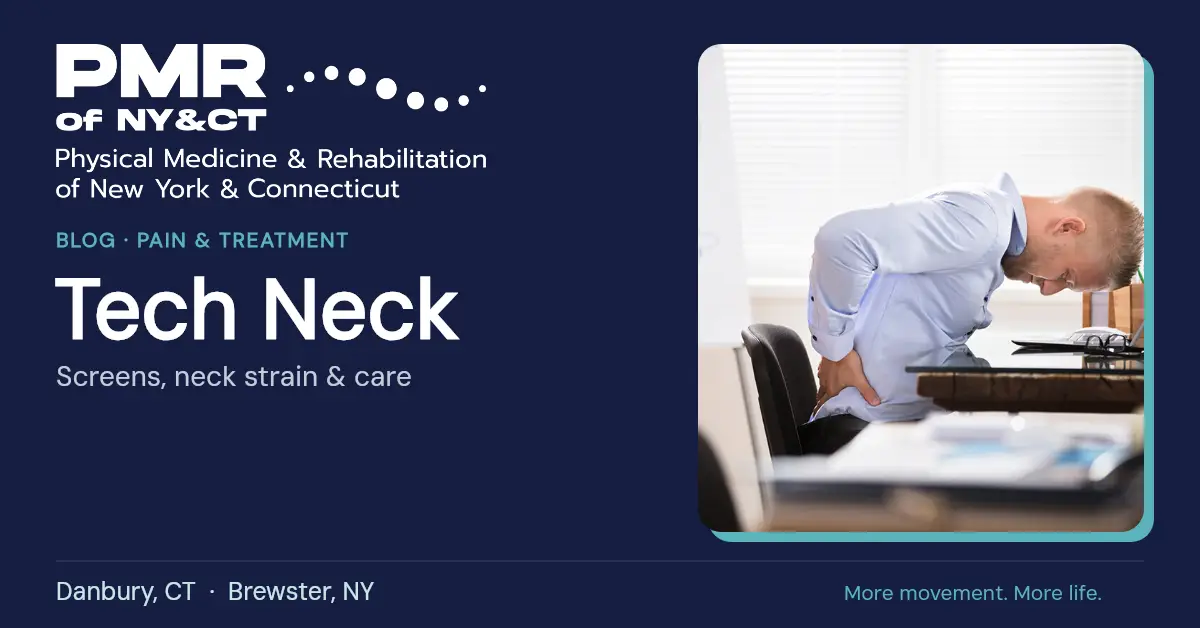
If your neck feels stiff after an evening of scrolling, or your shoulders ache after a day of messages and video calls, you're in good company. Tech neck, sometimes called text neck, is the popular name for neck and upper back strain that builds up when you spend long stretches looking down at a phone, tablet or laptop.
Tech neck isn't a formal diagnosis, and it rarely means your spine is damaged. For most people, it's a sign of tired muscles that have held your head forward for too long. Better device habits, regular breaks and a few simple exercises usually help.
What happens in your neck when you look down
Your head is heavy. When it sits balanced over your shoulders, your neck muscles work lightly. As it tips forward toward a screen, the muscles at the back of your neck and upper back work harder to hold it up, and biomechanical models suggest the load rises the further you bend.
Looking down now and then is harmless. Trouble tends to start with long, unbroken stretches in one position, day after day. Muscles tire and stiffen, and some people settle into a forward head posture, with the head drifting ahead of the shoulders even away from a screen.
Research on screen use and neck pain is mixed. Some studies link heavy device use with more neck pain, while others find no clear link with neck angle alone. How long you stay still and how often you move likely matter more than any single posture.
Common tech neck symptoms
Neck pain from looking down usually builds slowly over the day. You might notice:
- A dull ache or stiffness in the neck, often worse by evening
- Tightness across the tops of your shoulders
- Soreness between or around the shoulder blades
- Difficulty turning your head, such as when checking your blind spot while driving
- Tender spots or knots along the neck and upper back
Smarter ways to use your phone, tablet and laptop
You don't have to give up your devices. Instead, bring the screen up to you:
- Raise your phone. Hold it closer to eye level, and rest your elbows on a table or against your body so your arms don't tire.
- Prop up tablets and e-readers. A stand or folding case keeps you from reading with the device flat in your lap.
- Talk instead of typing. Voice-to-text and voice commands cut down on time spent hunched over a keyboard.
- Try the 20-20-20 rule. The American Academy of Ophthalmology suggests that every 20 minutes, you look at something about 20 feet away for at least 20 seconds. It rests your eyes and gives your neck a reason to lift.
Tech neck exercises to try
Go slowly with these gentle moves, and stop if one causes sharp pain, numbness, tingling or dizziness.
- Chin tucks: sit tall and glide your chin straight back, as if making a double chin, without tipping your head up or down. Hold for 5 seconds and repeat 10 times.
- Shoulder blade squeezes: draw your shoulder blades back and down. Hold for 5 seconds and repeat 10 times.
- Side neck stretch: tilt your right ear toward your right shoulder until you feel a gentle stretch on the left side of your neck. Hold for 20 to 30 seconds, then switch sides.
- Doorway chest stretch: rest your forearms on either side of a doorframe at shoulder height and step forward until you feel a stretch across your chest. Hold for 20 to 30 seconds.
- Upper back extension: sit in a chair whose backrest reaches your shoulder blades, support your head with your hands and gently arch back over the backrest. Repeat 5 to 10 times.
When to have neck pain checked
Screen-related strain usually improves with better habits. Make an appointment if:
- Pain hasn't eased after a few weeks of changes
- Pain spreads into an arm, or you feel numbness, tingling or weakness in an arm or hand
- Symptoms began after a fall, sports injury or car accident
- Neck pain keeps you from sleeping
Call 911 for neck or jaw pain with chest pressure, shortness of breath or a cold sweat, which may mean a heart attack, or for sudden weakness, numbness on one side or trouble speaking. Get emergency care for a stiff neck with fever, or severe neck pain or new arm numbness after a fall or crash.
Our neck pain page explains how we evaluate symptoms that linger, and medical massage therapy may ease muscle tension as part of a broader plan.
Frequently asked questions
Is tech neck permanent?
Usually not. For most people, stiffness and soreness improve within days to weeks once they change device habits, move more and strengthen the neck and upper back. A forward head posture built up over years takes longer to change, but strengthening helps at any age. Pain that doesn't improve deserves an exam to check for other causes.
Can tech neck cause headaches?
It can contribute. Tight, tired muscles at the base of the skull and across the shoulders are linked with tension-type headaches, which often feel like a band of pressure around the head. Breaks, stretching and better device habits may help. If headaches are frequent, severe or changing, see a doctor, and learn more about headaches and migraines.
Do kids and teens get tech neck?
They can. Children and teens often spend hours on phones, tablets and gaming devices. Encourage movement breaks, device stands for homework and plenty of active play. The American Academy of Pediatrics recommends a family media plan to set screen time limits that fit your household. Talk with your pediatrician if neck pain lasts or limits activities.
Ease neck strain with help from PMR
If screen time leaves your neck and shoulders stiff or sore, Physical Medicine & Rehabilitation of NY & CT (PMR) can find what's driving your symptoms and show you exercises that suit your day. Request an appointment and we’ll be in touch to schedule your visit.