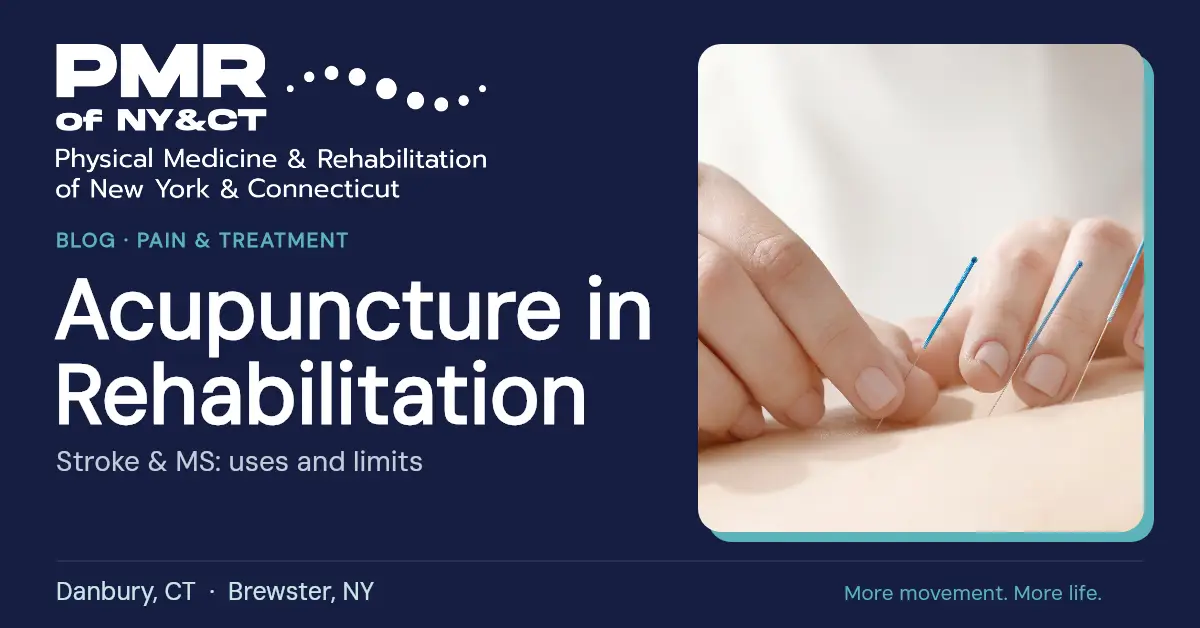
Recovering from a stroke, or living with multiple sclerosis (MS), can mean months or years of hard work to regain strength, balance and independence. Many people and families look at every option that might help, and acupuncture for stroke recovery is one that comes up often.
Here's what the evidence supports. Acupuncture may help some people as one part of a rehabilitation plan, but research results are mixed, and it doesn't replace physical, occupational or speech therapy. For MS, the evidence is more limited. And acupuncture has no role in emergency care: a stroke that is happening now needs 911.
Stroke is an emergency: know BE FAST
Most strokes are caused by a blood clot, and treatments that dissolve or remove it work best when given quickly, so every minute counts. Call 911 right away if you notice any of these signs, even if they go away:
- Balance: sudden loss of balance or coordination
- Eyes: sudden vision loss or double vision
- Face: one side of the face droops
- Arms: sudden weakness or numbness in an arm or leg, especially on one side
- Speech: slurred speech, confusion or trouble finding words
- Time: call 911 and note when symptoms started
Don't drive yourself to the hospital. Symptoms that fade within minutes may be a transient ischemic attack (TIA), a warning sign that still needs emergency care.
Is acupuncture for stroke recovery backed by research?
Acupuncture for stroke has been studied in many clinical trials, most of them in China, at different points in recovery. Researchers have looked at movement and walking, swallowing, speech, shoulder pain, muscle stiffness (spasticity) and independence in daily activities.
Reviews of these trials have found possible benefits for some of these problems, along with important limits:
- Most trials were small, and many had design weaknesses.
- Many didn't compare real acupuncture with a sham version, and in those that did, the benefits were much less clear.
- Results vary from study to study, and long-term effects are unclear.
The fair summary: acupuncture may be worth discussing as an add-on for some people, for example for pain or stiffness, but it hasn't been proven to speed stroke recovery.
Therapy is the core of stroke rehabilitation
Stroke rehabilitation is built on repeated, task-specific practice guided by a team. The fastest gains often come in the first few months, but many people keep improving for much longer with steady work. Your team may include:
- A physiatrist, a physician who specializes in rehabilitation and pain management, to guide the overall plan
- Physical therapy for strength, balance and walking
- Occupational therapy for daily tasks such as dressing, bathing and cooking
- Speech-language therapy for communication and swallowing
- Your primary care doctor or neurologist, to manage blood pressure and other risks and help prevent another stroke
If acupuncture is part of your plan, fit it around therapy rather than in place of it. Low mood is also common after a stroke; tell your doctor, because treatment can help.
Acupuncture for multiple sclerosis symptoms
MS is a long-term condition in which the immune system damages the protective coating around nerves in the brain and spinal cord. A neurologist leads treatment, which often includes disease-modifying medicines that reduce relapses.
Some people with MS try acupuncture for pain, fatigue, muscle stiffness, bladder problems or poor sleep. A handful of small studies suggest some people feel better, but the evidence is limited and inconsistent. There's no evidence that acupuncture slows MS, prevents relapses or repairs nerve damage, so keep up your prescribed treatment and tell your neurologist if you try it.
Physical therapy can also help with balance, walking, strength and energy pacing. Call your neurologist promptly about new or worsening symptoms that last more than a day, such as vision changes, weakness or numbness, since these may signal a relapse. If symptoms start suddenly, use BE FAST and call 911.
Safety tips before you start
Acupuncture from a licensed practitioner using sterile, single-use needles is generally low risk. After a stroke or with MS, a few precautions matter:
- Share your full medicine list. Many stroke survivors take blood thinners or antiplatelet medicines, which raise the chance of bruising.
- Point out areas with reduced feeling, where you may not notice discomfort or heat.
- Mention any history of seizures, a pacemaker, or a weak side that needs support when you lie down or get up.
- Get your physician's OK first, especially soon after a stroke.
Frequently asked questions
How soon after a stroke can you start acupuncture?
There's no set timeline. Studies have included people within days of a stroke and others months or years later. The right time is once your stroke team considers you medically stable and your physician agrees. Keep therapy as the priority, and track specific goals, such as walking distance or hand use, to judge whether acupuncture is adding anything.
Does acupuncture help with spasticity after a stroke?
Some small studies suggest acupuncture may ease spasticity, the muscle tightness that can follow a stroke, at least for a while. The evidence is low quality. Your rehab team may use stretching, positioning, splints and active exercise, and a physician may recommend medicines or botulinum toxin injections, which have stronger research support. Ask which mix fits you before adding acupuncture.
Can acupuncture repair nerve damage?
No. Acupuncture hasn't been shown to repair damaged nerves or brain tissue after a stroke, in MS, or in other neurological conditions such as Parkinson's disease. Research looks at whether it can ease symptoms, such as pain, and results are mixed. It also isn't a proven treatment for eye diseases such as glaucoma or macular degeneration, which need an eye doctor's care.